



Kindergarten Art Lesson 13
Working with Form, Making Play Dough Pinch Pots
Objective:
The student will understand what a form is by creating several different types of forms using play dough.
Materials:
Several different colors of play dough (enough for each student to have a handful)
Procedure:
Introduce the art element form. Note that we have worked with lines and shapes and a little bit with value and that now we will move on to the art element form. Form is a three dimensional object which has height, width and depth. Contrast this with shape which only has height and width. A square is a shape, a box is a form. Distribute the play dough (a small handful) to each student. Emphasize the importance of using the muscles in their fingers to manipulate the dough. Have them hide their hands with the dough in it and make a ball without looking. Next have them try to make a cube (box) without looking. Now put your clay in front of you and make a three dimensional version of the first letter of your name. Give the children time to roll out coils or snakes to use to make their letters. Next, give them a different color to use to decorate the letter with. Introduce the term pinch pot by explaining that a pinch pot is a form created by literally pinching the clay or dough into a useful form. Begin by making a ball. Sit the ball in your fingers and place your thumbs on the top of the ball. Press your thumbs down into the center of the ball, turn the form a quarter turn then press again. Continue turning and pressing until you have created a small bowl. Tap the top of the pot lightly on a table top to even out the edge. Next, choose a different color of play dough to use as decoration for your pot. Roll out coils or press small shapes to use in patterns around your work. Be sure to turn the pot around and attend to all sides with your decoration. Once you have finished, you can leave it sitting out to dry or simply disassemble it and put it back into the container.
Conclusion:
Have the students look carefully at their own work and decide what they like most about it. If the pots are left to dry out, a coat of clear acrylic spray paint, shellac or lacquer can be sprayed to add some permanence to the piece.
Artwork and Examples used in this lesson
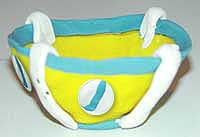
Teachers Example