


Fourth Grade Art Lesson 25
Preparing for Painting, Part 2 Painting with Primary and Complimentary Colors
Objective:
The student will know what the primary colors are and what the three sets of complimentary colors are. The student will fill in one of their shoe drawings using primary colors and the second with one set of complimentary colors. The student will practice controlling a paint brush and mixing colors.
Materials:
last lessons work, acrylic or tempera paint (red, yellow, blue and white the acrylics cerulean blue and magenta mix better than real blue), several small brushes, water, paper towel, newspaper to cover the work surface
Procedure:
Distribute each students work from last week. Explain that we will begin painting in each of the four drawings we made using a different color scheme in each one. Today we will do the first two. Ask the students if they know what the primary colors are. (Red, yellow and blue) Using only these three colors, paint in each of the shapes you have drawn off representing your shoe. Remember that the background will have to be painted also. Use the colors straight out of the tube/bottle. Pay attention to how you arrange your colors. You do not want to paint your shoe red and then the background red also. When you have completed the first painting, move on to the second. In this one, pick one set of complimentary colors to work with. The three sets are: 1. red and green, 2. blue and orange 3. yellow and purple. Because you have only the primary colors to work with, you will need to mix your secondary color. You will also need to mix your two complimentary colors in varying amounts to get enough colors to work with. Remember that the reason complimentary colors are complimentary is because when you mix two complimentary colors together you get a neutral tone. You may need to add a little bit of white to the neutral color you make. Paint carefully and control your paint brush. If you make a mistake it is pretty easy to go back over it after the top coat dries. Complete these two paintings and we will do the other two next lesson.
Conclusion:
Today you have worked with the primary colors and with complimentary colors. Notice the difference in the way paint straight out of the tube looks versus paint that has been mixed. What kind of difficulties did you face in trying to control the paint brush? If you have extra time, go to the arttango web site and look for enrichment on this particular exercise, or look up Pop Art on the internet to find famous works of art that used everyday objects as a subject matter for making fine art.
Artwork and Examples used in this lesson
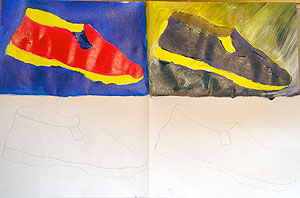
Teacher Example